
Ok, so they are working on F-150's, not slicks. But this is a great story.
http://www.farmshow.com/issues/33/01/330102.asp
Just need pictures now.
Pickups Powered By Tractor Engines Get 40 Mpg
More than a few FARM SHOW readers have installed a car or truck motor in a tractor. Gary Brown of Byron, Georgia, and a group of friends are going the other way, putting tractor diesels in cars and small trucks.
"The first one we did cost us about $18,000 and took four months to do," says Brown. "The last one runs smoother, gets better mileage, took about seven days to do, and cost about $6,000."
He says the difference was a combination of experience and finding new shortcuts. Perhaps equally important was knowing what they needed for parts and where to get them. In the book the group has published, they provide a complete list of sources.
"We found an outfit in Florida that sells transmissions and will custom build gears for half the price of our original source," says Brown. "We also found sources for motors and bell housings."
Because all six of the group's members are part time farmers and small business owners, the work has been done evenings and weekends. Since they first decided to chip in on some vehicles, Brown says they have spent more than $100,000 on the project. However, they also have three vehicles to use or sell.
"Our first project was to convert a Ford F-150 to diesel using an engine from a Ford 4600 series tractor," recalls Brown. "The engine is rugged and heavy duty. Because it was rated at only 55 hp, we added a small Vortec super charger that was originally designed for a four-cylinder Honda."
They rebuilt the engine, had the injectors and pump rebuilt by experts, and built new mounts to handle the engine, which was heavier than the original 302 V-8. They also had to box the brace that runs underneath to get the engine down low enough.
"We selected a Tremec T-5, five-speed overdrive transmission and found a bell housing from a straw blower machine," says Brown. "We replaced the clutch with an 11-in. automotive type for a 3/4-ton Ford truck. After buying a clutch, pressure plate and throw-out bearing, we discovered the throw-out was too long and had it machined to the proper length."
They resurfaced the flywheel and drilled new holes for the automotive pressure plate to fit the heavy-duty tractor flywheel. When they tried to mount the transmission, they discovered a 1/4-in. gap, took the measurements to a machine shop and had a ring machined to fit the space.
"When you encounter something that doesn't fit, you just have to stop and figure out what to do," says Brown. "With six people on our crew, we could usually figure something out or get the advice we needed."
For example, when they mounted the transmission, they realized the mount bracket was off a few inches and made an adapter out of a piece of 1/2-in. steel. Once it was bolted between the transmission and the mount, they discovered the shifter didn't line up with the hole in the floorboard.
"We talked to a friend who was a transmission expert, and he just laughed and told us to cut a new hole and seal up the old one," relates Brown. "We told him that then the shifter would be too close to the seat to shift into second and fourth. He laughed again and said, 'Just mount the shifter backward.'"
With the transmission and engine mounted, the driveshaft had to be shortened about 6 in. They used the power steering pump that came with the engine, but adapted the pickup's alternator to the new engine. "We replaced shocks and wheel bearings and serviced the rear end, replacing the lube with synthetic for less friction and improved economy," says Brown. He stresses that when seeking fuel economy, little things like the right lube and tires make a big difference.
Other changes needed included adding a vacuum pump for the booster on the power brakes, as well as the heat and air controller. The throttle cable had to be moved as well. Other basic modifications included replacing cables and connecting hoses where needed and adding a larger battery to turn over the diesel.
"We used a 12-volt radiator fan wired to a thermostat," says Brown. "It only runs when the engine needs it, but it will operate even after the engine shuts down."
They also removed the larger of the two fuel tanks and installed a 12-volt fuel pump. The exhaust system had to be reworked to accommodate the supercharger. A friend cut out a flange, and one of the group hand-built exhaust tubes and welded them to the flange.
"You need to be sure that all the tubes are about the same length," says Brown. "If one is radically longer, it can throw the engine out of balance." The clutch linkage also had to be replaced, as the pickup had one type of linkage and the bell housing had another. The group rebuilt and adapted what they needed, though Brown acknowledges there's an easier way.
"A dual cylinder hydraulic clutch system could be used in place of the linkage, but we like to suffer and do things the hard way."
Once the work was finished, the group took the truck for a test drive. "The three-cylinder had plenty of torque, but the overdrive gear was too high," recalls Brown. "We ordered a gear kit and dropped the gear ratio."
With the original engine and transmission, the pickup got just 13 miles per gallon, says Brown. The converted truck gets triple the mileage at about 40 mpg. Since that first attempt, Shade Tree conversions have done several more pickup conversions and a 1980 Ford Mustang. They've worked with three and four-cylinder motors with super chargers, turbochargers and natural aspiration.
"We believe the best formula is a four-cylinder with a turbo and a five-speed overdrive," says Brown. "We have a small Ford car that gets up to 50 mpg and pickups that get 40 to 50 mpg and can reach speeds of 100 mph."
Plans are available from Brown in either printed or digital form. Included are names and addresses of sources of engines, transmissions and other components. Also included are multiple high quality photos that cover key steps in the process.
Contact: FARM SHOW Followup, Gary C. Brown, 2191 Hwy. 247C, Byron, Georgia 31008 (ph 478 954-1283 or 800 998-7467; tractors@windstream.net; www.shadetree conversions.com)
Tractor engines in Ford trucks- Farm Show article
I read that article in farm show magizine...
i just am baffled why the manufactures (ford, chebby, ect)
drag their feet , instead of getting on the ball.
they need to relize that some of us are more interested in fuel economy than having a computer telling us where to turn, tempiture controllers that keep my feet 77* and my face 73*.......
i just am baffled why the manufactures (ford, chebby, ect)
drag their feet , instead of getting on the ball.
they need to relize that some of us are more interested in fuel economy than having a computer telling us where to turn, tempiture controllers that keep my feet 77* and my face 73*.......
.
.
.
'' I think what scares me the most about you guys is that I understand you '' ..... KID
'' lookin good, a little paint adds at least 100hp!'' ....... COOTER
'' well an old guy can dream cant he? ''............ICEMAN
''I would donate organs before selling my slick''........ HOOFBEAT RACER
.
.
'' I think what scares me the most about you guys is that I understand you '' ..... KID
'' lookin good, a little paint adds at least 100hp!'' ....... COOTER
'' well an old guy can dream cant he? ''............ICEMAN
''I would donate organs before selling my slick''........ HOOFBEAT RACER

The reason most auto manufacturers do not build these high mpg diesel vehicles for the U.S. is the emissions standards for all of our states on lighter vehicles. It can be done...Mercedes, Volkswagen, etc. have been able to develop these automobiles. The technology is out there they just won't use it! 
61 f100 shortbed unibody

-
65TremecGT
- Posts: 669
- Joined: July 23, 2006, 12:33 pm
- Location: So Cal

I love those mexico only crew cab rangers, neat little truck thats not weird looking like the sportrac. Would be a cool family car replacement, especially with a small t-diesel!
1965 Ford F-100 Short bed Custom Cab, Worn out six for now.
1966 F-250 Ranger waiting for a 79 460/C6 + Disc Brake and PS swap
1966 F-250 Ranger waiting for a 79 460/C6 + Disc Brake and PS swap
I think with CAFE standards likely going up we will soon see more diesels in the F150s and smaller trucks. I have driven a hybrid Tahoe, worked seamlessly. I still prefer a diesel to a hybrid due to it being sampler. Ivy hard a Toyota Prius leaves a larger carbon footprint (whatever that is) than an H2 due to manufacturing of the batteries.
-
ICEMAN6166
- Posts: 11470
- Joined: July 11, 2006, 11:28 am
- Location: Dove Creek, Co. elevation 6842

altuough i think its a cool idea
right now it would be a bad investment for me
gas here is $2.61 a gal.
diesel is $3.29
68 cents per gallon more and the cost of doing all the work to mount a tractor engine plus the gelling in cold weather of either "new diesel" or frenchfry oil means a heated tank(pay $ to electric co.) so it would seem that i would need to get 75 mpg with the diesel for it to pay off.
right now it would be a bad investment for me
gas here is $2.61 a gal.
diesel is $3.29
68 cents per gallon more and the cost of doing all the work to mount a tractor engine plus the gelling in cold weather of either "new diesel" or frenchfry oil means a heated tank(pay $ to electric co.) so it would seem that i would need to get 75 mpg with the diesel for it to pay off.
1966 F250 4x4
1964 Rambler Ambassador 990
Rest in peace departed Slick family members
Cam Milam
Lesley Ferguson
Steve Lopes
John Sutton
1964 Rambler Ambassador 990
Rest in peace departed Slick family members
Cam Milam
Lesley Ferguson
Steve Lopes
John Sutton


-
ezernut9mm

- Posts: 9141
- Joined: July 21, 2006, 9:37 pm
- Location: KCMO

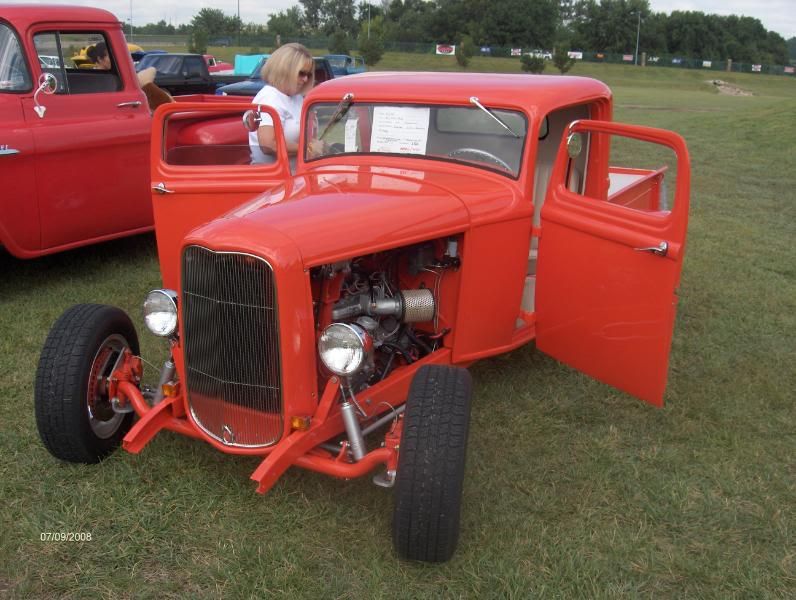
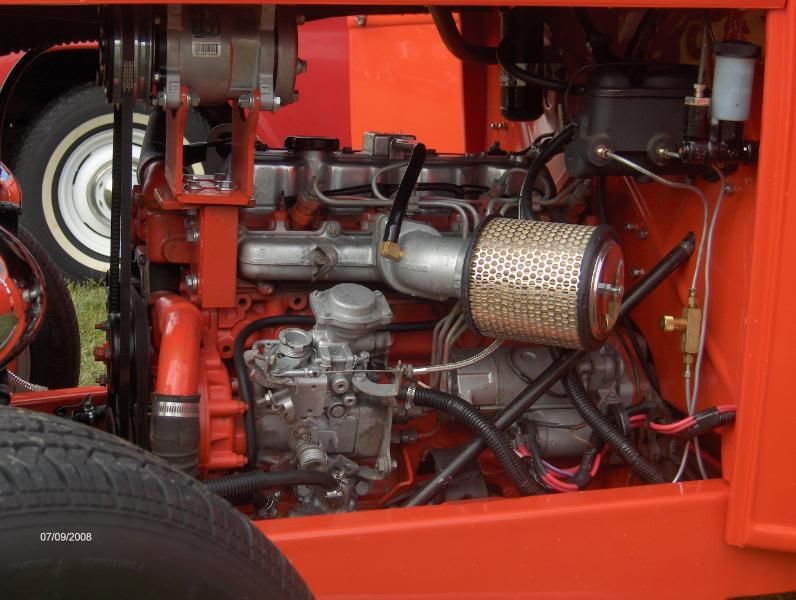
saw this at the local truck show last year. i forget what kind it was, but he claimed 50mpg.
always
"i believe i've achieved satisfaction".-bubbles
"should i be gettin" baked for this boys?"-bubbles
i could no longer keep "r.i.p.ing" all of our fallen brothers and sisters, so i say here, slick loads of love and much respect to all you beautiful people.
"i believe i've achieved satisfaction".-bubbles
"should i be gettin" baked for this boys?"-bubbles
i could no longer keep "r.i.p.ing" all of our fallen brothers and sisters, so i say here, slick loads of love and much respect to all you beautiful people.
That "poppin' John" crack brought to mind a truck I saw in Swift Current years ago. A bunch of Hutterites were moving across country and the engine in their Ford 3-ton blew up. It was carrying a JD 830 popper. They cut a hole in the box floor and ran a chain from the tractor PTO down to the center U-joint on the truck driveshaft. The tractor was facing the "wrong" way, so the PTO was turning the right way (PTO'S turn opposite to normal engine rotation) and they had a guy sitting on the tractor running the clutch and throttle. They weren't breaking any speed laws, but they were goin' down the road! Farmer fix of the first water! The contraption was doing about 30 mph, so they must have had a bigger sprocket on the 540 rpm PTO.